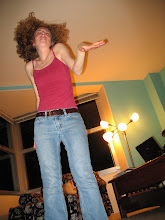
I've decided to take action. I'm looking for new experiences--ones that make me feel like an active participant or collaborator. I feel like a cheeseball saying this, but I'm trying to create a sense of intellectual excitement, emotional vitality, and--dare I say it--well being. In the last couple of weeks, I went to my first yoga class since college; I polled friends for good non-fiction books and started reading; I redecorated part of the living room; I helped make a stone wall for a theatrical set; I explored an unfamiliar part of the City; and I made a new friend. I feel like I'm slowly shaking off the winter-time stupor. It will be interesting to see if this continued regimen will bear fruit. I think it might.
Sunday, January 30, 2011
Making Stone
I've been seeing a lot of art and theatre, but I haven't been inspired to write about it. Mostly because I haven't been connecting on a deeper emotional level. Am I learning more about the human condition? I suppose. Am I experiencing beauty? Sometimes. Am I being exposed to new idea? Sure. So, what's the problem? It feels passive. And while I can't expect to have a transcendent experience every time I see a work of art, I wish the feeling was coming a little more often.

Saturday, October 9, 2010
Museum of the City of New York
Kate and I visited the Museum of the City of New York today. She had never been. I had only visited once before. We were both surprised to discover most of the museum was closed for renovation. I guess we should have read the website before we showed up.
In any event, we strolled through both of the special exhibitions and the period room hall. The clothes in Notorious and Notable: 20th Century Women of Style were pretty fun. But then again, costumes always are. I was a little put off by the labels. If I were taking a shot every time I read the word doyenne, I wouldn't have made it out standing up. Still, I did learn such interesting tidbits as English-born actress Angela Lansbury presided over the centennial celebrations for the Statue of Liberty (she wore a red Glinda-the-Good-Witch-get-up) and Rosamond Bernier is still alive.
I actually enjoyed the period rooms a great deal. I got to run through my mental Winterthur checklist. It's been a long time since I had looked at any dec. arts and I was delighted to discover I hadn't forgotten everything I was taught. I was a little surprised at the French stained-glass window amidst all the period rooms. I should have read a label to see why it was there.
After going through the museum, Kate and I walked through the Central Park Conservatory Garden. It was lovely. A wedding party was gathered around the fountain and they couldn't have asked for a prettier, sunnier day. Kate told me I should come back in the late spring when it's awash in roses if I wanted to be really impressed by the walkways and vistas. I better go ahead and put it on the calendar.
Sunday, October 3, 2010
Blessing of the Animals
All things bright and beautiful,
all creatures great and small,
all things wise and wonderful:
the Lord God made them all.
Across the street from my apartment is a beautiful Catholic church. I'm delighted every morning when I wake up to the sun rising above it's eaves, especially in the winter when the "rosy-fingered dawn" turns the snow a pale pink. In the evening, the setting sun bathes its rose window in glorious light. In the summer, I'm often treated to hymns when they throw their doors open to let in a breeze and the lovely music floats up to my office windows. On the weekends, I watch as wedding party's parade in and out the front doors. The church's beauty is a cherished part of my life in Park Slope, and yet I've never been to a service, nor been through its doors.
This morning, the church celebrated St. Francis of Assisi and welcomed all to bring their animals to be blessed. Annette and I were returning from the gym and decided to join the throng of people and dogs on the church steps. While the dogs sniffed each other and twined their leashes around their owners' legs, the priest read a selection of passages from the Old Testament. I'm not Catholic (or religious), but I was moved by the beauty of the readings, the celebration of our animal friends, and the gentle admonitions to love all creatures. It felt right to participate in such a joyous moment and recognize that kindness transcends religion and creed.
As I write this, Charlie is cuddled up next to me and I'm looking out my window onto the church lit up by its historic street lamps. Charlie's presence is made even sweeter by my morning diversion and the warm lights below are more dear for the welcome I felt as I joined the small gathering on the steps. Now, let's just hope I can hold onto these warm feelings when Charlie is waking me up at 5am for crunchies.
Saturday, September 18, 2010
Men Akimbo
There's more to NYC than the fine and performing arts. My next few posts are going to look at the life in NYC generally. For my first new-style post, I'm taking the NYT complaint box as a model.
Men on the subway: you take up more than your fair share of space. Close your legs. You don't need three feet between your knees. Particularly when it means you're taking up the better part of 2 other seats.
My personal space is important too. I like having a distinct area that is mine. Your leg is not welcome. Why don't you put your legs together when someone sits next to you? I make room when you sit down next to me. In fact, like most women I politely and embarrassedly compact myself.
Perhaps men's wide legs are a birthright. Leg-spreading certainly starts young. One day I spotted an empty seat between a 50 year old woman and an 11 year old boy listening to his ipod. His legs were spread and clearly in the seat bubble next to his, but I figured he's young enough that he thinks I'm a real grown-up that deserves respect. So, I sat down. Like much older members of his gender, the kid did not move his leg. I sighed and settled in for the discomfort.
So, guys, please while we're all stuck on the train together, close your legs. It's a small, crowded island we live on. Don't make it feel even tinier and denser than it already is with your far apart legs. There's nothing wrong with crossing your legs. You don't look silly. In fact, you look respectful and aware that you're sharing the subway with others. Thanks.
Sunday, September 12, 2010
Glamour Travel
My first business trip ever was to Gainesville, Florida followed by a jaunt to Des Moines, Iowa to see the site of a sculpture park under construction. Interesting? Absolutely. Glamorous? Not very. Last week, I got sent to Venice to wrangle media at one of the national pavilions. Interesting? Absolutely. Glamorous? Yes very (if you ignore the mosquito-bite welts I got from sitting outside the Pavilion all day).
I have a strict personal rule that I won't write about clients. And I won't break it now. However, I do want to share the experience of visiting Venice for the first time. It's a beautiful place and a puzzling one—geographically and culturally.
Amazingly, everyone can give you directions in English. Venice is an island for tourists. I learned that if I said my few Italian phrases with enough sweet vigor and my thick American accent, the stranger/waiter/shopkeeper I was speaking with would take pity on me and speak in English. In fact, I'm almost a little disappointed that I only had one language mishap. I was in a cafe waiting for a meeting to start and I heard the waiter deliver to the table behind me, "una Coca Cola." Fantastic, I thought to myself: I don't have to order water or coffee (the only things I knew the Italian words for). So the waiter comes over and I give him a big smile and say, "Prego, una Sprite [please, a Sprite]." He looks slightly befuddled and returns a few minutes later with a luridly orange drink with an orange slice and an olive floating in it. I'm so hot and thirsty that I shrug, say "grazie," and take a huge swig. It was so bitter that I nearly spit it out. When I told the ladies at the Peggy Guggenheim Collection this story later they howled with laughter. I had unwittingly ordered Venice's famed "spritz"--a soda and campari cocktail.
What I found thought provoking about the city was its sense of self. I felt like I was walking through a very large movie set. My American sensibility searched for dynamism, a sense that the past, present, and future all had a place on the sinking isles. Rather, it’s identity as a tourist destination has caused it to be frozen in time. Preserved for the very tourists who stop in for a few days hungry for experience and then who move on to the next experience.
The US, so young in comparison, seems so much more enchanted with its own past and celebrating it. We have markers everywhere talking about significant people or events. We have statues in most of our public parks and markers to our wars. That's largely missing in Venice--not that I could have read them if they existed. Still, I wanted to leave with that sense of history and veneration for the past.
Tuesday, September 7, 2010
Terrified at the Arsenale
I have been moved, puzzled, bewildered, and awed by works of art. Until last week, I had never been terrified by a work of art. Imagine a pitch black gallery, light from the gallery leading into it illuminates the eight large columns that run down the center in pairs. Jumping, switching, writhing electric wires snap and crackle between them. It’s mesmerizing and terrifying. Those are live wires. How can you have live wires in an art installation?
At the end of the gallery was a tiny, backlit doorway. There were more galleries to see, but I couldn’t tell how much I actually wanted to see them if it meant walking next to the wires. So, I simply stood and looked some more, forcing my rising panic down. Upon closer examination, the light I thought was coming from the wires was coming from strobe lights mounted on top of the columns. I slowly started to edge my way along the gallery wall and as I did my feet squelched. The floor was damp. Where on earth did this water come from? The wires weren’t wires at all. They were hoses. The snapping and crackling sounds I heard were water hitting the rubber floor. The strobe lights reflecting off the water created the electric effect.
I was relieved and chastened and I hated the piece. I felt manipulated and silly. But I couldn’t stop thinking about it over the next few days and when people asked me about impressions of the Arsenale, I always returned to that piece and shared my chagrin about being duped. I’ve actually come to appreciate the piece and admire its cleverness and ability to play on my expectations. Only after reading reviews of the Venice Architecture Biennale did I realize the piece was titled Split Second House and it was created by Olafur Eliasson. If I had known the artist I might not have been so shaken when first viewing the work, Eliasson’s obsession with water is well known. But then, I might not have had such a pure reaction.
Saturday, July 31, 2010
An Art Road Trip Upstate
Last weekend, Patty, Katie, Rebecca, Nate and I piled into Rebecca's car to go upstate to see some art. Rebecca was desperate to see the exhibition Carolee Schneeman: Within and Beyond the Premises at the Dorksy Museum on the campus of SUNY New Paltz. Katie wanted to see the Serra sculptures at Dia: Beacon. Patty and I are always interested in seeing art, but mostly we just wanted to escape the city for the day.
We had a fun drive to New Paltz and discovered a really good used bookstore. By really good, I actually mean that the sales rack felt familiar. A lot of the books for sale were ones already on my own bookshelf or ones I had already read and enjoyed. I had the impression that any book I walked out of the store with, I'd probably like. Unfortunately or not (probably better for my wallet), I got hustled out before I could make my decision.
After lunch at a diner on New Paltz's main streeet, we made our way over to the Dorsky to see some contemporary feminist art. I had never heard of Carolee Schneeman before the weekend and if Rebecca, a curatorial assistant in the Elizabeth A. Sackler Center for Feminist Art at the Brooklyn Museum, hadn't been with me I would hope to never hear of her again. There was no wall text and minimal tombstones, so, I simply had to look at the art. Transcendental it was not. Schneeman's work was perhaps the most profane and solipsistic I had ever seen. Feather dusters held in her anus. Scrolls pulled out of her vagina. Close-ups of her nipples and clitoris. I wrestled with the intellectual openness born of my liberal education and the middle-class sensibilities ingrained by my rearing. I discovered (perhaps to my chagrin) that my sensibilities were stronger. Then Rebecca started talking about the art work and the historical gestalt in which Schneeman was creating these pieces. Things made a lot more sense when I realized she came of age during the first wave of the feminist movement and was a student at an art school that told her as a women she could not do abstract or edgy or provocative art. I still don't like the art, but now I can appreciate it--which sometimes is more important than liking.
After the Dorsky, we headed off to Dia: Beacon. I hadn't had the best experience last time. But almost a year later going in with the idea that I would probably feel disgruntled and alienated I had a great time. I didn't try to meet Dia: Beacon at their level; I met them at mine (which is to say I didn't take anything too seriously). We went specifically to see the Serra sculptures and I can honestly say I experienced something close to awe. I felt the soaring-inside-my-chest feeling, like when I walk inside a really tall, vaulted cathedral. The sculptures were incredible--tall, steel plates that curved with only a person-wide opening to walk through. One sculpture had another sculpture inside it and you walked through the exterior wall and then walked around the interior wall until you found the opening. The feeling it evoked is what I expect you're supposed to feel when you walk around a mandela. This wonderful sense of peace, discovery, and wonder. I even laid down inside this one and just looked up. While I might have only seen a warehouse ceiling, my mind's eye saw blue sky. I had the narrowed appreciation that comes with forced tunnel vision.
All in all it was a great trip.
Saturday, July 3, 2010
Greenwood Cemetery (or, my new favorite place)
There's a park in Brooklyn where no one goes. There are verdant vistas, untrammeled grass, and empty paths--in short, paradise in an overcrowded city. Of course, the reason it may be so empty is because it's a cemetery. For some reason people tend to be creeped out about hanging out around the dead. It's their loss--Greenwood Cemetery is awesome (and strangely life-affirming).

A group of us put together a self-guided tour of the Cemetery today. We were each responsible for finding a min
ute or two of things to say about a grave or landmark from a
pre-compiled list. We all took it seriously too, sussing out interesting tidbits to share with the group. I spoke about the amateur Egyptologist Albert Ross Parson's mausoleum, which is a miniature pyramid decorated with a fascinating mix of Christian and Egyptian iconography. The juxtaposition of motifs make a lot of sense when you consider that he wrote a book called, "New Light from the Great Pyramid" that explored how ancient Egyptian culture and religious beliefs could elucidate different teachings from the Bible.
Katie spoke about the quaker parrots that have taken up residence in Greenwood's gates. Ornothologists believe they somehow escaped from a crate being unloaded from a plane at JFK in the 60s. The bright green, loud birds spread all over the city, apparently, but the Parks Service routed them out of Central Park unmercifully because they were afraid they'd force out the native species. The folks at the Cemetery let the birds be and were actually rewarded for their salutary neglect. The parrots did displace the pigeons who roosted in the gate and whose corrosive droppings were eating away at the stone (apparently, quaker parrot poo doesn't harm stone).
Kate gave us a rousing talk about the Battle of Brooklyn, which took place on the Cemetery's highest hill. That battle is credited as being the point at which Washington could have lost it all. The British were trouncing the Americans. Washington needed to retreat and regroup. He left 400 men on the hill to hold the Brits off as he got the rest of the troops to safer ground. All but 9 of those men died defending the hill. But their effort was not for naught--Washington and his troops escaped, evading the Brits, and continuing our nation's fight for independence. Kate also introduced us to a statue of Minerva, the Roman goddess of wisdom, who stands in direct line with the Statue of Liberty. Minerva eternally raises her hand in salute to Lady Liberty.
Everyone in the group gave great talks (and Allison did a great job leading us around) and we realized that there's still way more of the cemetery to see and enjoy. We're definitely planning on going again en masse. in the meantime, I might just need to go visit on my own. It's such a beautiful, calm place.
Saturday, May 29, 2010
Brooklyn Museum
Last weekend, Katie, Patty and I went to the Brooklyn Museum to see the costume show, American High Style. It was excellent, but then exhibitions of old clothes almost always are. There is something innately fascinating about costumes from another period; they are so familiar, yet so other.
This afternoon, I went back to the BM to look around and read the wall text in the Egyptian galleries at my leisure. I didn't find the the layout of the galleries intuitive and wasn't quite sure how to move through them to move through time and read the interpretation in chronological order. So, I abandoned that and just did a lot of looking and read a lot of object labels--I became most interested in the materials the objects were made of. Most of Tut's stuff is gold, wood, or some form of alabaster. The objects at the BM were more work-a-day with many being some type of ceramic or carved stone. Not surprisingly the craftsmanship of objects made for non-royals wasn't as fine either. It must have been nice to being a living God on earth and have a God's send-off into the afterlife.
 While I was at the Museum today, I also went and paid a visit to my favorite work of art in the collection, Martinque Woman by Malvina Hoffman. It's an arresting black marble sculpture of a larger-than-life woman's head. The interplay of textures and color--her smooth, flawless, dark black skin juxtaposed against the rough, stippled carving of her grayish white hair--is delicious. She gazes at the entrance of the gallery, pulling the viewer in and demanding their consideration. It's a powerful piece in a gallery of exceptional artwork.
In fact, I had forgotten how much I liked her gallery, a sort of hodge podge of late 19th/20th century paintings and sculptures located in front of the American Wing's Luce Center. It's the eclectic, thoughtfully curated nature of the gallery that makes it so gratifying. At the front of the gallery, are folk-art sculpture of animals--a giraffe's painted head, and two fierce lions, carved from salvaged railroad ties and whose whiskers are made of wires. Beyond them is a marble statue of a woman, a late-19th century interpretation of classic Greek statuary. It's not very good (actually), but it's juxtaposition against the untrained folk art carver and across from Hoffman's statue, shows the range of sculptural work happening in America within a 60 year period.

Rounding at the gallery's look at sculpture is John Koch's homoerotic painting The Sculptor. The foreground depicts a naked, male model lighting the cigarette of the sculpture who is taking measurements of his calves and thighs with calipers. In the background stands a monumental sculpture, depicting a Grecian figure (perhaps Hercules?) battling some sort of monster. The focus of the painting is the finely rendered model's back, with it's rippling back. The figure is more sculptural than the sculpture in the background, which acts almost as a mere placeholder.
I'm pretty darn lucky that I'm only a 10 minute walk from the Brooklyn Museum. It's become my defacto hangout when I have a spare hour or two. Every time I am delighted and charmed. It's, honestly, a privilege to become familiar with a collection through repeat viewings.
Monday, May 17, 2010
"Restoration" at NYTW
I’m tickled when theatre looks at the art world. It’s no surprise then that (after I got over my opening scene heart attack) I enjoyed “Restoration” at New York Theatre Workshop on Friday.

Photo Courtesy of www.sdnn.com. Ticket courtesy of Annette.
Sunday, March 21, 2010
Fighting my inner curmudgeon about social media
On an institutional level, I think social media is a pretty neat thing. On a personal level, I wish someone would permanently crash the servers at Facebook and Twitter.
I've been thinking a lot about social media lately. A couple of weeks ago, I attended Social Media Art Camp, a two-day conference that took a broad look at the cultural landscape and discussed how social media could become a pivotal transformation point for how arts organizations engage with their audiences. It was all very kumbaya (and predictable) as the speakers discussed how different platforms on the web can create a virtual gathering places, allowing people to share their thoughts and come together to discuss common interests, desires, thoughts on past programming, and ideas for new events.
I should like social media. It's useful and taps into a collective knowledge. It's democratized the cultural conversation, allowing anyone to participate. It's made our cultural institutions appear more transparent and customer-service oriented. Unfortunately, when practiced by hundreds of individuals as a part of their personal lives, I often find it nauseating as we all strive to prove to our friends and followers the meaningfulness of our lives and the uniqueness of our own perspective (I do recognize that I have a blog and a Facebook account and that I'm a hypocrite).
Arts institutions and individuals have different goals. Institutions are self-perpetuating machines. In the most basic Darwinian sense, they ensure their survival always. Social media might eventually be the tools that most successfully allow them to retain audiences outside of their hallowed halls. Of course, they still need to create great experiences inside those halls.
Social media makes clear an odd tension in the human psyche, both the desire to stand out and the desire to fit in. We all participate because of the herd mentality (and because some real-life people have achieved popular media fame through the great equalizer--we all are waiting to be the unique exception plucked from obscurity). What's the cost of our new interconnectedness?Is the momentary pleasure from discovering that the vain cheerleader from high school gained 50 pounds worth the now life-long commitment to having her as a "friend"? Not all people are supposed to stay in our lives forever. In fact, it's sort of freeing to leave a few behind. Moreover, do you really want to discover how self-involved your acquaintances are through their status updates? As for Twitter, boiling down observations to 140 characters doesn't make your quotidian interesting. In fact, it's sort of depressing. It's the moment when I most wish the conversation hadn't been democratized.
So, is there anyway to just have arts orgs use social media and leave everyone else behind? (I didn't think so, either).
The Snarks
This weekend, instead of watching theatrical magic, I'm actually getting to create some of my own. I'm volunteering with the Snarks, an amateur all-female theatre troupe that just celebrated it's 100th birthday. They're producing "Mornings at Seven," a 1939 comedy by Paul Osborne.
The Snarks (mostly women in their 50s, 60s, and 70s) share space with the Amateur Comedy Club, which owns an adorable carriage house on Lexington and 36th. On the first floor is a tiny stage and seating for about 75. The second floor houses the work room, dressing rooms, meeting room, and kitchen. The first time I entered I felt like I had gone home. The spirit of the place reminded me so much of Wellesley's Shakespeare Society, where women did everything and ran everything together.
Yesterday, about 20 women and a few men gathered to finish building the set. Even a simple set takes a lot of work and we had our work cut out for us. My partners and I screwed homasote to the stage floor and glued down green carpet squares for grass. Grass laying was the best part, the "lawn" areas weren't square, so we had to cut the square up as if we were making a jigsaw puzzle.
It was wonderful to be back in a theater and to get my hands dirty. It was nice to feel the sense of instant camaraderie that a show produces and to come together to create a unified artistic product. I'm really looking forward to running the lights next weekend.
Wednesday, February 3, 2010
So Impressed with BAM
Last night, a representative from BAM called me. He began by noting that it was my first time buying tickets for a production there and he wanted to know what I had thought about As You Like It. My first response was shock, my second response was to begin speaking as quickly as possible. I've never had the opportunity to tell a professional theatre what I thought of their production (and I've certainly never taken the initiative to write to one after seeing a performance). That I hated the performance was beside the point; I felt all warm and gushy inside because I got to share my thoughts and, in some small measure, they counted. Someone at the organization actually cared.
Before my phone died (I couldn't believe it, I was so enjoying myself), the BAM representative and I had a wide ranging discussion (or was wide-ranging as you can get in 5-8 minutes) about directorial choices, competent Shakespearean training, and name-brand actors vs. relative unknowns. Throughout the conversation, I made it clear that I took issue with director Sam Mendes's choices and placed the blame squarely on his shoulders. My dislike of the production, at this point had nothing to do with BAM as an institution. Still, I think the rep was slightly taken aback-- after I had leveled the first criticism he did say, "Well, tell us how you really feel." To which I might have responded: sugar-coating my disdain doesn't do you any good.
Still without that call, I'm not sure how soon I would venture back to BAM. I certainly have no desire to go see The Tempest, the second play in the Bridge Project, directed by Mendes, and which starts in rep soon. I also didn't even know what was next in their season until that call. But after the call, I'm curious to see something else. I'm even hoping that I get called again. I like that this place called me. I'm just one of the unwashed masses, but BAM has democratized the experience. Even though I only bought a $31 ticket in the balcony, my opinion matters. They are blatantly cultivating my patronage and I love it.
BAM, I'll be back soon. Thanks for listening and for being so gracious about my informed dislike of the production. This is the start of a sustained interest in you as an institution and your productions. I'm looking forward to forming my second impression of you.
Saturday, January 30, 2010
As You Like It
On Thursday, Annette and I went to see BAM's As You Like It. We were pretty excited since we had both worked on it in college; I had directed and Annette had been my stage manager. We love the text and had high expectations for this production. They were quickly dashed. The director Sam Mendes squeezed everything joyous and lovely out of the script. It was cold, dark, and depressing.
Actually, it shared quite a lot in common with Sir Peter Hall's production, which I had seen in Boston my junior year, and which was equally as disappointing. Both Hall and Mendes's versions embraced the cold elements of the play--emphasizing the harshness of the world and man's precarious place in it. Both featured snow covered stages and modern-slob dress. Both downplayed Rosalind, making her almost an appendage to the male characters, who they clearly found more interesting. Frankly, it made me yearn for a professional production by a woman director.
To me, the play has always been a study in artifice. A play which sets a cast of characters in a court where they must use their wits and smarts to survive. Rosalind must be an exemplary, tough as nails woman who does not show the psychic damage of being the daughter of a banished duke. Outside of the court she must pass herself off as a man in order to protect her physical safety. Orlando is a youngest son forced to hide his light under a bushel so as not to provoke the rage of an eldest brother who is not as intrinsically good as he. Touchstone and Jaques may place themselves in the positions of fools, but they are the cleverest and most clear sighted of the bunch. Ultimately, it is the vividness and truthfulness of Rosalind and Orlando's characters that forces them beyond artifice to embrace who they truly are and restore peace to Arden.
Saturday, January 23, 2010
Americana Week
At my first auction, I fell asleep. The room was warm; I was exhausted from a week of forced marches through New York to see as many antiques and museums as possible; there weren't any chairs and I was sitting propped up against a wall. But really, those are just excuses. I fell asleep because I was bored out of my mind.
At first, there was sort of an ironic fun in watching poorly-dressed people bid on objects for thousands of dollars (one had to suppose their discretionary funds were entirely devoted to their antiquing mania). It was kind of intriguing to watch Sotheby's employees sitting at the phone banks intently whisper-narrating the auction floor to a bidder. It was even mildly exciting to watch people raise their paddles on the floor and be recognized by the auctioneer--"150,000 to the gentleman standing in the back. 160,000 to the lady seated to the left." But that was the first 15 minutes. Then it became a sort of monotonous litany that accompanied a slideshow that seemed to loop every 20 minutes or so. Oops, there's another side chair. Wait, didn't we see that card table before. I know I saw that folk art painting of a child just a few minutes ago. In any event, I didn't have a real desire to ever attend another auction.
Imagine my own surprise then when I found myself accompanying Patty to Sotheby's this morning. She was meeting Katie there to watch the "Important Americana" auction and I promised to meet Sarah (a 2nd year Winterthur fellow and a dear friend from college) there in the afternoon to get some lunch. I figured I might as well just go see the auction too; maybe, I'd like it better this time. Again, the people watching was pretty good for the first 15 minutes. There were even a couple of on the floor battles, and I got to observe Leslie Keno at length. I think I've found the new brand-face for Energizer batteries--I have never seen someone look so perpetually engaged and excited for quite so long. But even Leslie couldn't detract from the fact, that it was the same schtick over and over--"20,000. Fair warning, selling for $20,000. Peer intently around the room. Sold. Sharply rap the rapper thingie.... 40,000. Fair warning, selling for $40,000. Peer like a bird of prey for a rival bid. Sold."
Luckily, I didn't have to be bored the entire time. I had brought along We Two: Victoria and Albert-Rulers, Partners, Rivals--an intriguing biography that examines both monarchs' childhoods and the power dynamics that drove their relationship. I picked it up after seeing the movie Young Victoria with Emily Blunt. I couldn't quite believe that the movie accurately reflected her character or her relationship with her husband. It just seemed too modern. It turns out I was largely right. The book "complicates our historical understanding" (to borrow a phrase from the pedants) of the relationship and shows how the social mores of the age even constricted the life of the Queen of England, the most powerful person in the land. In any event, Patty told me later she was relieved I had brought the book. She said I acted the part of the dutiful boyfriend on a shopping trip. To which, I should reply: Just doing what I can. Some people's furniture is another girl's shoe shopping.
Monday, January 11, 2010
A Weekend Spent Largely at the Met

Skipping out of order: on Sunday, Sal and I ventured up to 190th St. to visit the Cloisters, the Met branch dedicated to medieval art and architecture. Sal joked that we had ventured so far from Brooklyn that we were likely to see unicorns roaming the streets. Little did he realize that we actually had entered the land of unicorns. The Cloisters are home to the "Unicorn Tapestries," an incredible collection of 16th century tapestries that depict the hunting of unicorns.
Though I had some inkling of what to expect, nothing quite prepared me for the splendor of seeing these tapestries in person. They are beautiful, whimsical, and heart-rending. There is a vivid aliveness to their representation, as if the men marching through the forest will step out of the tapestry and into the gallery themselves. In The Unicorn is Killed and Brought to the Castle one can almost hear the men on castle's ramparts whispering to one another.
We explored the rest of the Cloisters too, but nothing is quite as breathtaking as those mind-boggling tapestries. I doubt if Athena's tapestry of the gods at play on Mt. Olympus could have rivaled these. How on earth could someone have woven, by hand, these intricate, detailed images. How does thread become an rabbit's eye that twinkles with such rabbity good humor?
On Friday night, Patty and I had the pleasure of taking a private tour of American Stories: Paintings of Everyday Life at the Met. Our friend Katie is a curatorial assistant in the

American Wing and has spent the last year working on the exhibition. She also authors the exhibition's blog (make sure to check it out). On our tour, she regaled us with stories of how the show came together--from choosing the paint colors on the gallery walls to writing labels to make sure the color correction in the catalogue was correct. We particularly enjoyed this shop talk because Patty and I had our own small part in the exhibitions' behind the scenes. On a road trip in the Berkshires, we drove Katie to the Smith College Museum of Art so she could look at the sky in a Lily Martin Spencer painting in person. Happily, it really was blue and not the yellow the museum's slide indicated it was.
But about the show: it was pretty great. It sweepingly showed how America perceived and conceived it's nationhood from the time of the Revolution to the start of WWI. It's only open until the 24th, so head over to the Met soon. It's unlikely that such an impressive grouping of American paintings will be seen together anytime soon.
Saturday, November 21, 2009
The New York Transit Museum
 Like most New Yorkers, I take the subway everyday and I take it for granted. Unless the train is running slowly, I never stop to think about how the subway runs, how it was built, or even how metrocard revenue is collected and counted. My visit to the New York Transit Museum today was informative and, more importantly, fun.
To enter the museum, visitors (appropriately) descend down the stairs of a decommissioned subway station at Boerum Place and Schermerhorn Street. A friendly staff members sells tickets from a historic ticket booth (I wish they still made them with beautifully varnished, turned wood bars). The museum's first gallery is a passage with a low burlap cloth ceiling, which evokes the feeling of being in an early, unfinished subway tunnel. The passage is papered in historic images that show the construction of the city's first subway. There's also great clips from newspapers of the day that feature quotes from workers who survived freak accidents, the city officials who celebrated the new initiative, and critics who lauded the city's technological advancement. And I was surprised to learn that the subway began as a private enterprise and was not a civic amenity until well into the 20th century.
One of my favorite displays in the museum illustrated the evolution of the subway's fare system,
 from paper tickets to tokens to today's metrocards. The best part were the examples of fake tokens that people had passed off as the real thing, including a quarter that someone had taken the pains to punch a "Y" out the middle of, just like a real token from the '70s. The board of fakes perfectly illustrated a conversation Sal and I had on our way to the museum. As he tells it, there was a coin in Costa Rica that was the exact size, shape, and weight as the MTA subway token. Illegal vendors on the street would sell a bag of the coins for a few dollars to fare evaders. Still, even the metrocard introduced in 1994 and fully phased in by 2004 experienced evasion kinks when it started. Someone discovered if you creased the magnetic strip just so, the computers in the turnstiles would think a valueless card still had enough value on it for a ride.
In the same gallery as the subway tokens are old station turnstiles. The first turnstiles had heavy wooden arms and were operated by an attendant who pushed a footlever which allowed a passenger to turn the arm and enter the station. It's a far cry from the sleek, polished stainless steel, computer operated turnstiles the MTA uses today. We even learned why the sides of the today's turnstile are slanted and the barred passage is so narrow. The slanted slides keep people from getting a purchase on top, so they can't jump over the arm. The narrow entrance dissuades people from crouching and going underneath the arm. Given that challenge and the opportunity (we wouldn't be arrested for fare evasion in the museum), we took turns sneaking through the turnstile. We also tested the other historic turnstyles and loved that the museum allowed us to interact with and touch the artifacts (after withstanding millions of people year after year, what's a few thousand more at the museum?).
The lowest level of the museum is the decommissioned station's platform, where 19 subway cars dating from 1904 to the present are lined up on the downtown and uptown tracks. Down the center of the platform are interpretative boards with detailed descriptions of the subway's evolution. Outside each subway car is a label telling the car's length of service and context of use. Interesting fact: subway cars were wooden until an accident shattered one and killed 93 people in 1918 After that cars were made of metal. Another interesting fact: subway revenue used to be collected at the stations at night and then taken by specially guarded subway cars on dedicated tracks to a carefully concealed money room in Brooklyn (since 2006, it's taken by armored car to Queens).
The subway cars are open and people are free to wander in and out, sit on the seats, and hang on the straps. In the cars, we spent a lot of time looking at the old maps--graphic design has come a long way--and the old advertisements, which have been around since the very beginning. As we were traveling back to Park Slope, we looked around at the ads in our car and realized that the ads have evolved a lot. There are fewer of them and they're longer and horizontally oriented. Even up until the 1970s, there were more and they were smaller, with a more vertical orientation. Our ads push services , sell tourist experiences, or are sponsored by the MTA to make you feel good about the transit authority. The historic ads sold goods.
I really can't gush about the museum enough (I'm just going to ignore the exhibit on Robert Moses, which I thought had confusing explanations and illustrations of the Triborough Bridge) because I left so energized. I love when I go to a museum and it dynamically teaches me about a segment of the world I interact with everyday. I love that the museum allowed me to explore and touch the artifacts. I liked that my experience interacting with the museum objects was informed by and now informs how I relate to my everyday environment.
Monday, August 17, 2009
Dia: Beacon - The Opposite of a Love Affair
I love MASS MoCA. I hate Dia: Beacon. Both museums exhibit modern and contemporary art in rehabilitated and converted factories. My affection for the former and my distaste for the latter led to an important realization: I feel ambivalent about art from the second half of the 20th century. To understand and enjoy works of art from this time period, I need interpretation that is both well-written and accessible.
My first, engaged experience with contemporary art was at MASS MoCA, as part of a
So, by the time, I got to Dia: Beacon on Saturday, I felt comfortable looking at contemporary and modern art. I was also looking forward to seeing how another museum rehabilitated and converted a factory space. The physical museum is glorious. There are broad galleries, flooded with natural light from windows and skylights. The floors are luscious, distressed, blonde wood. The ceiling rafters are exposed and in the Flavin gallery, fluorescent tube lights nestle along them, creating a sort a dialogue between those pragmatic fluorescents that light the space, and the artistic fluorescents that are Flavin's artwork.
Despite how enamored I was of the physical space, I was alienated and provoked by the installations’ interpretation. The wall labels are perfunctory—an artist’s name and the title of the work (I'll admit, good for those who like unmediated artistic experiences). For those who need help understanding contemporary art, there are receptacles with laminated, essay-like labels. Unfortunately, those labels are exercises in mental masturbation. The prose is verbose and the sentences are poorly constructed. The label writers try too hard to conform to an academic style that favors jargon over comprehension. “Mythemes of glass, axiomatic status, and the phenomenology of color" are all vaunting phrases--precocious to the point of illogic--that communicate nothing. And, ultimately, the labels made me mistrust the art. The interpretation was so overwrought that I had to wonder, is the emperor naked?
I was also shocked that there was no way to participate with the museum. In fact, one form of engagement—photography—is not allowed at all. Most museums encourage their visitors to take part in some way, whether through picture-taking or in more active, creative ways. At MASS MoCA, I’ve contributed to an exhibition that asked visitors to write on sticky notes and I’ve shared my impressions in (analog) comment books sprinkled throughout the galleries (I've also taken many photographs). At the
The audience at Dia: Beacon is a segment that most museums strive to attract—Gen Y. The nature of Dia: Beacon’s collection lures Gen Y to the museum, but I doubt the museum is nurturing long-term relationships. Dia: Beacon does not use any of the new social media to retain or engage a generation which believes that personal expression is an inalienable birth right and that the internet is a democracy that allows any one to tke part in the conversation. One day Dia: Beacons's survival may depend on an engaged Gen Y and it's time they start taking the steps to build their relationships with them. They need to allow photography. They need to create a Facebook page. They should twitter. They should vivify their website. Perhaps if Dia: Beacon uses the new media I might begin to feel like a participant in the museum's mission, and not like a neophyte at the alter of ART.
(Head over to Retrograde Design for Patty's take on our visit.)
Saturday, July 25, 2009
The BPL: My New Favorite Place

I've spent the past two Saturday mornings at the Central branch of the Brooklyn Public Library. I'm in love; the place is magical and whimsical.
The building--at first glance--is imposing, with a strangely concave front facade. Yet--on second glance--it is ameliorated by unattributed quotations about the power of reading. The quotations express wonderfully idealistic sentiments about the place of books in culture and the transformative effect of knowledge. The library's very physical shell is an ode to the idea of books as instruments of self-improvement. After reading the library's website, I discovered that the building's physicality is meant to evoke the materiality of a book. "The spine is on Grand Army Plaza and the building's two wings open like pages onto Eastern Parkway and Flatbush Avenue."
 The steps leading up to the library are shallow and short, which induced me to skip and skim my way up, just like when I'm hurriedly reading a well-plotted book to figure out what will happen next. Once inside the building and past the first information desk, there's a soaring foyer of gray marble and honey colored wood. It feels deliciously calm, but not at all solemn. Off the foyer is the children's reading room and the literature reading room. On the second floor are the nonfiction reading rooms. All are incredibly large, sunny, and inviting. I spent several happy hours wondering up and down the stacks.
What I especially love about the Brooklyn Library is that, while not a university library, it's still a very serviceable research library, with an extensive and diverse nonfiction collection. Having grown up in the 'burbs of Georgia, I was almost convinced public libraries were architectually welcoming, but largely buildings that only housed popular reading, the classics, and some how-to manuals. I was delighted to wonder in today and pick up a treatise on the condom industry in the US, a historical study of the creation of a teen culture over the course of the twentieth century, and a Brits memoir of the American homefront during WWII. I'm in eclectic heaven.
Friday, July 10, 2009
The 21st-Century Promenade
 The City is replete with hip places to see and be seen. The newest and, ironically, most egalitarian is the Highline--a park on the old elevated train tracks that used to run from Gansevoort Street to 20th Street, between 10th & 11th Avenues (see the map). Forget strolling anywhere else in the city during twilight, everyone is flocking to the magical, green oasis in the sky.
 For good reason: the park is awesome, which stems--in part--from its novelty. The shocking juxtaposition of vibrant wildflowers with dead-looking city buildings is delicious. The ability to look at architectural details on level is delightful. Then there's the built-in teak benches which overlook the river during sunset. I also particularly like how the wildflower are planted between the old railroad ties.
But, the best part of my visit last week was the unexpected, unofficial jazz band that had set up on the fire escapes of an apartment building that overlooks the 20th St. entrance. The trumpet and trombone players scatted. The drummer rat-a-tat-tatted and the piano player provided the melody everyone started swinging to. New York is the only place where life sometimes really can be a musical--where joy transcends and infuses a moment so that the only thing one can do is sing and dance.
Subscribe to:
Posts (Atom)